

Aisla Pinto (BA Cand),
Jose Francis Llenado (RPsy, MA.Org Psy, BS Psy),
Carolyn Burr (M. Lead, Grad Dip Couns, BA)
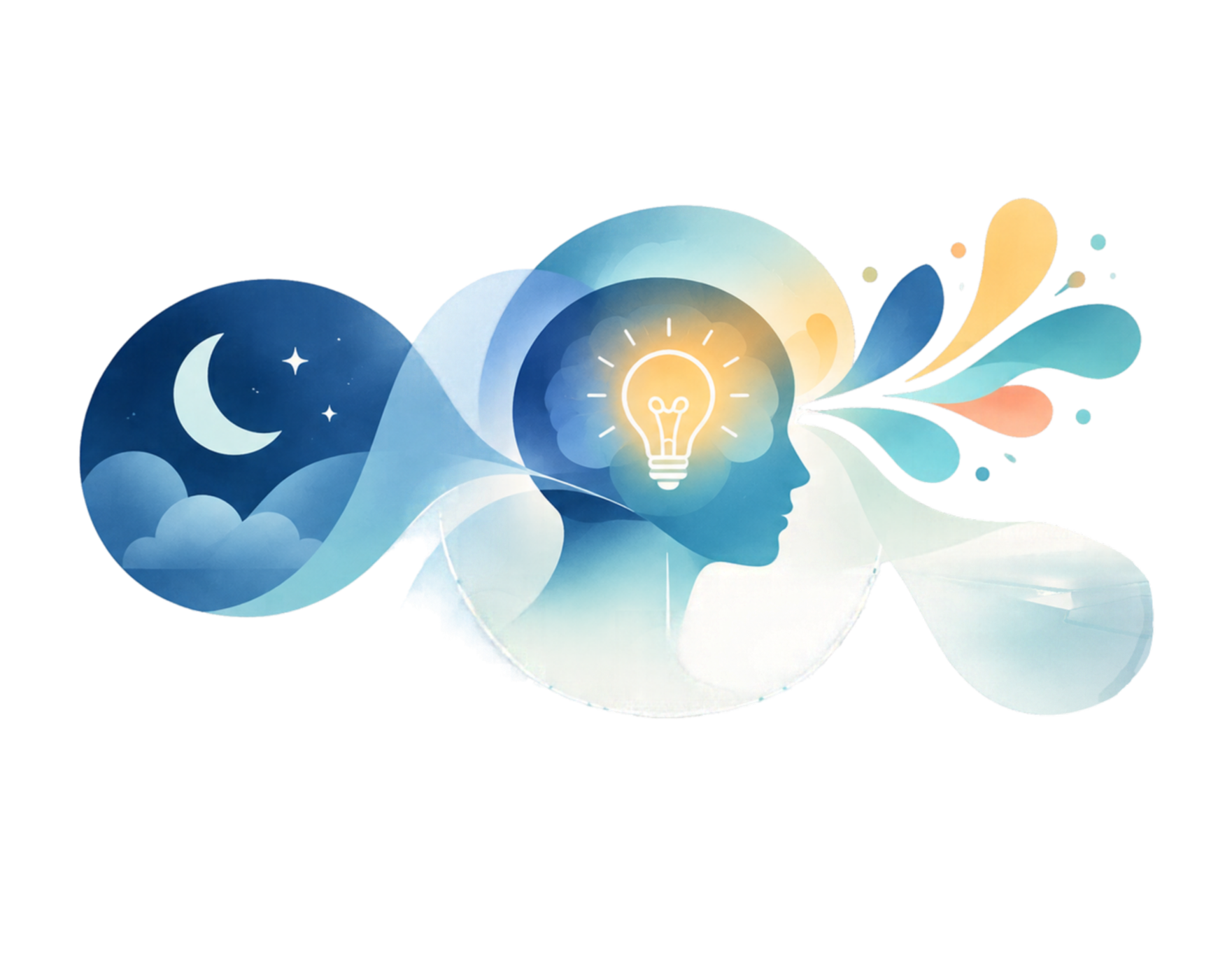
Sleep and Creativity
Creativity can be a touch elusive. Search for it, command it to rise and it will inevitably likely fade just when it is needed. Instead, creativity may be influenced by many factors, including whether we have given the mind time to refresh, recharge and/ reset.
One essential component of this process is having sleep. The familiar saying ‘a good nights sleep’ a sage indicator of the wisdom and relevance of beginning the day rested, alert and bright eyed (and bushy tailied!). This becomes particularly relevant when we apply the concept of sleep in today’s globally skilled workforce, where pace, generating ideas, problem solving, making connections and thinking beyond conventional boundaries are increasingly valuable. These capabilities require a mind that can be acutely focused, adaptable and exploratory.
So, when we consider this context, sleep becomes an important (and perhaps sometimes overlooked), contributor to conditions that open up workplace creativity.
Research suggests that insufficient sleep can be detrimental to some aspects of creative cognition at work, although findings vary depending on the tasks and activities (Lim, Williams & Bullock, 2025). Sleep patterns and individual circadian preferences may also influence when people perform cognitive tasks most effectively. These findings do not suggest that sleep alone determines workplace creativity, but they do indicate that rest and recovery may form part of the broader conditions that enable creative thinking to rise. Sleep therefore has practical implications for how organisations create conditions that supports creativity an increasingly important focus as creative thinking remains ranked as one of the core future skills expected to grow in relevance (World Economic Forum, 2025).
Based on the interests of sleep, this article considers the relationship between sleep, creativity and some considerations and implications for organisations. Research in this area uses several related but distinct outcomes, including insight, associative thinking, creative cognition and innovative behaviour. These findings collectively point to a possible relationship between sleep and creativity-related processes, but they should not be treated as measures of precisely the same capability.
Adequate Sleep and Creative Cognition
Research has identified several ways in which sleep may contribute to cognitive processes associated with creativity. In this sense, sleep should not simply be perceived as a period of inactivity. To this point, in a study by Wagner et al. (2004) it was found that participants who slept after learning a task were more than twice as likely to find a hidden solution than participants who remained awake. The findings indicate that sleep may, in some instances, facilitate insight and restructuring of previously learned information. Additionally other research suggests that REM Sleep may support associative thinking, helping us understand and connect information or ideas that initially seemed unrelated (Cai et al., 2009). Similarly, other researchers found that task reactivation during sleep can also trigger creativity-related processes, thereby enhancing sleep's effect on creativity (Ritter et al., 2012). Together, these findings suggest that sleep plays a role in creativity by helping individuals discover solutions to problems, connect seemingly unrelated ideas, and strengthen creativity-related processes overall.
In addition to sleep duration and quality, individual circadian preferences may also matter. Chronotype, an individual’s natural preference for when to sleep and be most active during the day, naturally differs from person to person. Biological and environmental factors influence it, but it does not remain fixed throughout an individual’s lifetime. For example, finding in research suggested that sleep preferences and patterns change during different life stages (Roenneberg et al., 2007). Research has also explored whether creativity varies according to the alignment between chronotype and time of day. Kühnel et al. (2022) found evidence that chronotype moderated the relationship between time of day and creativity. Across three studies, late chronotypes were more creative in the late afternoon, while early chronotypes tended to be more creative in the morning.
These findings indicate that timing may matter. For organisations, this raises the possibility of considering whether greater flexibility around when certain tasks are undertaken could bring greater support to team members. That said, it is important to recognise that chronotype is only one influence among many and should be considered alongside broader operational, team and workforce settings.
This leads to an interesting question. Is poor sleep really that detrimental to one’s creative abilities?
Research in workplace contexts suggests there may be important connections between sleep, mood and innovative behaviour. For example, Williamson et al. (2019), in a study of entrepreneurs, found associations between these factors. While the findings are valuable, the study focused only on a specific occupational group.
However, the relationship between sleep and creativity has also been considered more broadly. Lewis, Knoblich and Poe (2018) put forward that sleep may contribute to creative problem-solving through the reorganisation of existing knowledge, with different stages of sleep (REM versus non REM) potentially supporting processes such as extracting patterns and forming novel associations.
Research within workplace settings also points to a wider relationship between sleep and the resources people bring to work. Schleupner and Kühnel (2021), studying employees from diverse industries, found that sleep quality was positively related to work engagement, with mental health playing an important mediating role.
Perhaps the broader point is not simply that sleep matters, but that creative capacity depends somewhat on the conditions surrounding the individual. Rest and recovery can help sustain the cognitive resources needed for creative work. Viewed this way, sleep is not solely a personal matter. It also invites organisations to reflect and consider whether the way work is structured assists or inadvertently works against the conditions in which people can think creatively.
This raises another question - Could one of the secrets to more creative workplaces sometimes be knowing when to look for when to switch off, rather than looking at when to switch on?
Practical Organizational Implications
Organisations can explore how sleep and recovery can be considered within work design. Rather than suggesting how or when to sleep, one option is to consider whether everyday working practices create enough space for rest, recovery and renewed cognitive energy.
For example, Olson et al. (2015) examined employees with greater control over their work schedules. Compared to a control group, these employees slept an average of eight minutes longer per day, whilst this was a small improvement, employees nonetheless reported better sleep. This provides one example of how changes to workplace design or structure may influence employees' sleep.
Research involving shift workers provides another perspective. Vetter et al. (2015) examined work schedules designed to take workers' chronotypes into account and found improvements in sleep duration and reductions in circadian disruption.
Together these illustrations, indicate that work design may offer a practical way to consider how work can be managed to support cognitive strength and creativity.
For organisations, three practical considerations might be:
a) Consider how workplace practices are providing opportunities for team members to rest and recover between working periods;
b) Provide flexibility in working arrangements where possible; and
c) Recognise that individuals may differ in preferred working and sleeping patterns
These approaches also have potential benefits for overall employee wellbeing.
Takeaways
Sleep appears to play a key role in several cognitive processes involved in creative thinking, including those discussed around insight, associative processing and problem-solving.
Research also suggests that insufficient sleep can impair some aspects of creative cognition. However, greater exploration is required between sleep and workplace creativity.
Individual differences do matter. Chronotype and time of day may influence when some people are better placed to jump into cognitively demanding or creative tasks (recognising also that this within occurs with a much larger set of individual and organisational influences).
For organisations, one of the most useful implications may be that how workplace conditions are established can influence people's opportunities for sleep and recovery, and these conditions deserve deep consideration for organisations aiming for sustainable cognitive performance and creative work.
Hence, although sleep is unlikely to be a one-step formula for innovation, better understanding how rest and recovery relate to the way people think, learn, solve problems and contribute creatively may offer organisations another valuable lens for supporting sustainable creativity at work.

This Article contains cited materials from existing evidence-based sources. All referenced content is cited using APA format to ensure academic rigor and transparency. A comprehensive list of references is provided at the base of the article, as well as in text citations is the article sections
This article was developed by the contributors, drawing on the evidence-based sources cited throughout and listed below. AI was used to support language simplification, reference formatting, and to identify additional potential relevant sources. These were cross checked.
References
Cai, D. J., Mednick, S. A., Harrison, E. M., Kanady, J. C., & Mednick, S. C. (2009). REM, not incubation, improves creativity by priming associative networks. Proceedings of the National Academy of Sciences, 106(25), 10130–10134. https://doi.org/10.1073/pnas.0900271106
Kühnel, J., Bledow, R., & Kiefer, M. (2022). There is a time to be creative: The alignment between chronotype and time of day. Academy of Management Journal, 65(1), 218–247. https://doi.org/10.5465/amj.2019.0020
Lewis, P. A., Knoblich, G., & Poe, G. (2018). How memory replay in sleep boosts creative problem- solving. Trends in Cognitive Sciences, 22(6), 491–503. https://doi.org/10.1016/j.tics.2018.03.009
Lim, A. R., Williams, B. J., & Bullock, B. (2025). The effect of sleep deprivation on creative cognition: A systematic review of experiment-based research. Creativity Research Journal, 37(4), 712–722. https://doi.org/10.1080/10400419.2024.2343508
Olson, R., Crain, T. L., Bodner, T. E., King, R., Hammer, L. B., Klein, L. C., Erickson, L., Moen, P., Berkman, L. F., & Buxton, O. M. (2015). A workplace intervention improves sleep: Results from the randomized controlled Work, Family, and Health Study. Sleep Health, 1(1), 55–65. https://doi.org/10.1016/j.sleh.2014.11.003
Ritter, S. M., Strick, M., Bos, M. W., van Baaren, R. B., & Dijksterhuis, A. (2012). Good morning creativity: Task reactivation during sleep enhances beneficial effect of sleep on creative performance. Journal of Sleep Research, 21(6), 643–647. https://doi.org/10.1111/j.1365-2869.2012.01006.x
Roenneberg, T., Kuehnle, T., Juda, M., Kantermann, T., Allebrandt, K., Gordijn, M., & Merrow, M. (2007). Epidemiology of the human circadian clock. Sleep Medicine Reviews, 11(6), 429–438. https://doi.org/10.1016/j.smrv.2007.07.005
Schleupner, R., & Kühnel, J. (2021). Fueling work engagement: The role of sleep, health, and overtime. Frontiers in Public Health, 9, 592850. https://doi.org/10.3389/fpubh.2021.592850
Vetter, C., Fischer, D., Matera, J. L., & Roenneberg, T. (2015). Aligning work and circadian time in shift workers improves sleep and reduces circadian disruption. Current Biology, 25(7), 907–911. https://doi.org/10.1016/j.cub.2015.01.064
Wagner, U., Gais, S., Haider, H., Verleger, R., & Born, J. (2004). Sleep inspires insight. Nature, 427(6972), 352–355. https://doi.org/10.1038/nature02223
Williamson, A. J., Battisti, M., Leatherbee, M., & Gish, J. J. (2019). Rest, zest, and my innovative best: Sleep and mood as drivers of entrepreneurs’ innovative behavior. Entrepreneurship Theory and Practice, 43(3), 582–610. https://doi.org/10.1177/1042258718798630
World Economic Forum. (2025). The future of jobs report 2025. https://www.weforum.org/publications/the-future-of-jobs-report-2025