

Neuroinclusive Design
Carolyn Burr, M.Lead, Grad Dip Couns, B.A.
Jose Francis Llenado (RPsy, MA.Org Psy, BS Psy)

What is Neuroinclusion?
Neuroinclusion refers to the creation of environments, practices, and processes that accommodate a full spectrum of neurological differences (neurodiversity) and cognitive processing styles in how people sense, perceive, process and interact with the world.
It emphasizes listening to, valuing, and supporting neurodivergent individuals, including those with autism, ADHD, anxiety, and sensory processing differences, whose ways thinking and interacting differ from dominant norms, ensuring environments, practices, and processes are usable and supportive for all.
What is Neuroinclusive Design?
Neuroinclusive design, in the context of work and living spaces, aims to enhance sensory comfort, adaptability, and functionality, strengthening tenant experience, retention, and long-term asset performance without compromising architectural quality or return on investment.
In the built environment, inclusive design has historically focused on physical accessibility such as ramps, elevators, and compliant circulation. While essential, these measures address only part of the accessibility landscape.
Neurodiversity is far less visible and more prevalent, even to neurodiverse individuals themselves. Because these needs are not immediately apparent, they are often not taken under consideration during design, resulting in office and living spaces that inadvertently increase stress, distraction, and exclusion.
Most contemporary architecture prioritizes visual appeal and space efficiency as drivers of market value and tenant demand, often overlooking sensory comfort. Design choices such as excessive brightness, reverberant layouts, and high-contrast finishes can increase cognitive load and reduce day-to-day usability, and as a result, leave spaces under-utilised.
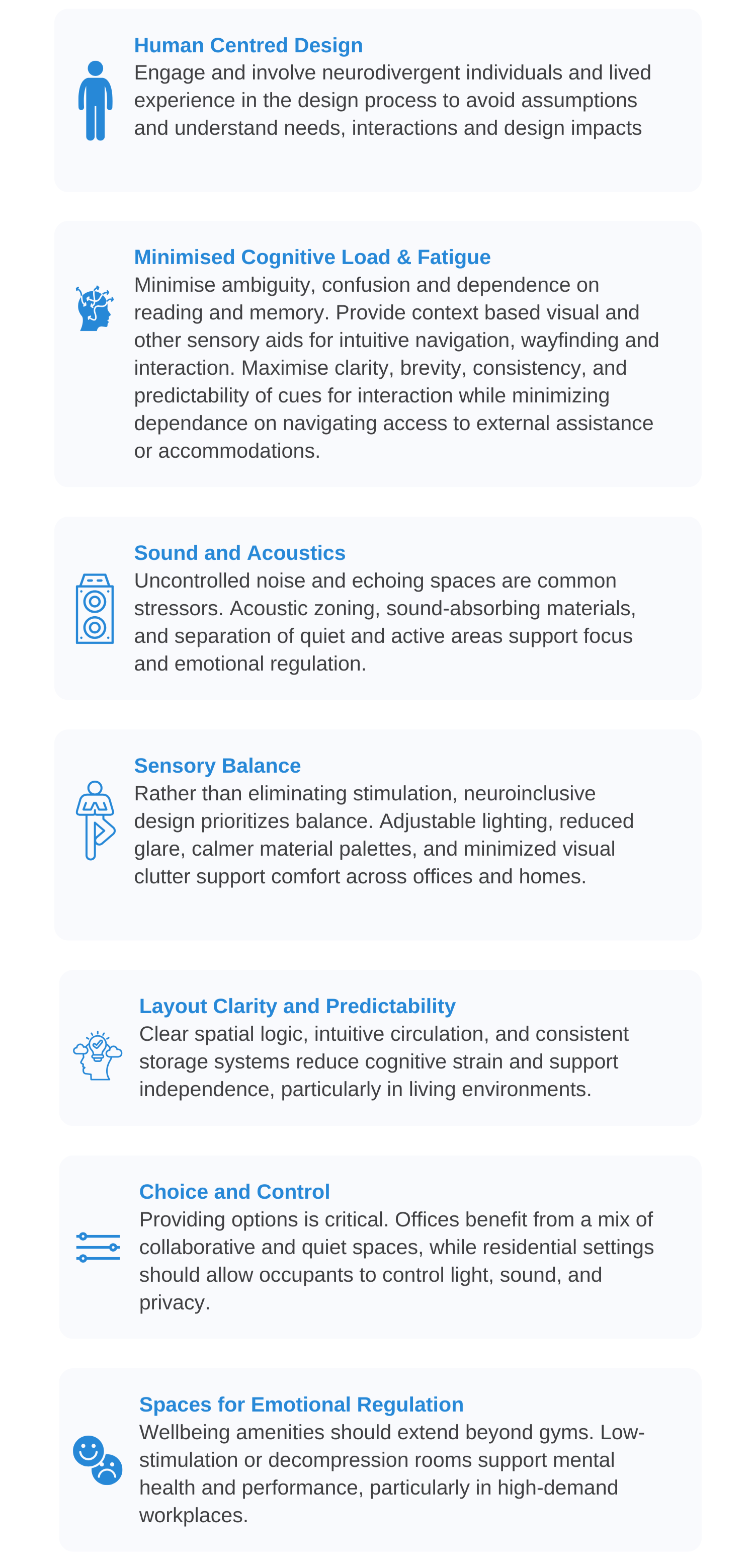
Key Design Considerations for Neuroinclusive Spaces
Neuroinclusion in Practice
Dubai International Airport (DXB):
Dubai International Airport is the world’s first airport to receive Certified Autism Center (CAC) status. The airport supports neurodivergent travelers through trained staff, autism-friendly procedures, and structured assistance that reduces stress while maintaining high operational efficiency.
Toronto Pearson International Airport (YYZ):
Toronto Pearson supports passengers with invisible disabilities through Quiet Rooms, “Ready, Set, Fly” rehearsal programs, and Sunflower lanyards that discreetly signal the need for additional support. These initiatives are integrated into a major international transport hub without disrupting passenger flow or design standards.

Role of Untapped
Untapped works to advance neuroinclusion through awareness, education, and applied design guidance. Untapped supports partners with various institutions in Australia, Europe and North America to help integrate neuroinclusive principles into their services.
Rather than positioning neuroinclusion as a specialist add-on, Untapped promotes scalable, practical neuoinclusive solutions by design that align with commercial objectives. Current work includes the development of a sensory-inclusive commercial kitchen in Melbourne’s inner west, delivered in partnership with Studio Tate, The Green Boat, RMIT University, and Untapped.

Inclusion and Performance
Neuroinclusive design enhances asset performance rather than competing with efficiency. Environments that reduce cognitive fatigue and stress support higher productivity, stronger tenant retention, and improved long-term usability.
Context matters:
Properties located near high-noise corridors or dense urban infrastructure may require additional buffering to remain suitable for inclusive use. When applied thoughtfully, neuroinclusive principles refine modern architecture and strengthen asset resilience.

The Return on Investment
Neuroinclusive office and living spaces represent the next evolution of high-performing real estate. As hybrid and remote work become structural, the built environment increasingly influences focus, comfort, and productivity.
From an asset standpoint, neuroinclusive design can reduce operational risk, lower turnover, and future-proof properties against evolving expectations around wellbeing and inclusion. What was once viewed as a consideration is now a marker of quality, relevance, and long-term value. Through collaboration with partners such as JLL, councils, and industry leaders and with the specialist expertise of Untapped, neuroinclusive design can be embedded as a practical, scalable strategy for shaping the future of work and living.

The Evidence Base
Neuroinclusive workplaces and biophilic design: Strategies for promoting occupational health and sustainability. (Hutson & Hutson, 2023), explores how integrating natural elements into office environments can reduce stress, improve productivity, and support neurodiverse employees. Biophilic design—through features like natural light, greenery, water elements, and soundscapes—has been shown to enhance cognitive performance, creativity, and overall well-being. The authors emphasize that neurodivergent individuals, who often experience heightened sensory sensitivities, benefit significantly from multisensory and multimodal environments. Beyond health, biophilic design also contributes to sustainability by reducing energy use and carbon footprints, aligning workplace inclusivity with smart city goals.
Designing neuroinclusivity with Triple Empathy Theory (Josefson, 2025), builds on Double Empathy Theory and the Dialectical Misattunement Hypothesis to propose Triple Empathy Theory as a framework for designing inclusive societies. It argues that communication challenges between neurotypical and neurodivergent individuals stem from mutual misunderstandings rather than deficits. Triple Empathy Theory adds a third dimension: the need for designers and policymakers to balance empathy across all neurotypes when creating social and physical infrastructures. This approach reframes neurodiversity as a natural variation of humanity, advocating for relational, rights-based models that empower neurodivergent people and foster reciprocal cultural attunement.
Aminpour, Skattebol, & Katz, (2025) also examines how preschool environments can better support neurodivergent children by integrating inclusive pedagogy with spatial design. Using a qualitative Delphi method with experts in education and architecture, the study identifies key design features such as managing acoustics, reducing clutter, providing retreat spaces, ensuring clear layouts, and incorporating natural environments. Findings emphasize the importance of aligning Universal Design for Learning principles with physical spaces to foster predictability, diversity, and self-regulation. The authors caution against reliance on special-purpose spaces that may reinforce segregation, instead advocating for co-design processes involving educators and children to create inclusive, adaptable preschool environments.
These studies highlight a convergence between environmental design and cultural theory in advancing neuroinclusivity. They show how physical spaces can be reshaped to reduce stress and enhance productivity for neurodiverse workers and also provides a theoretical lens for ensuring that such designs are rooted in mutual empathy and human rights. The implication is that sustainable, neuroinclusive workplaces require both material interventions (biophilic design, XR technologies) and cultural frameworks (Triple Empathy Theory) to create environments where diverse neurotypes can thrive. This convergence points toward a holistic model where neurodiversity is supported from preschool through adulthood, ensuring environments are not only accessible but also empowering across the lifespan. These further suggest that the future of smart workspaces lies in green infrastructure and in empathetic, relational design that bridges differences across neurotypes.

This Article contains cited materials from existing evidence-based sources. All referenced content is cited using APA format to ensure academic rigor and transparency. A comprehensive list of references is provided at the base of the article, as well as in text citations is the article sections

Some grammar in the article was revised with the assistance of AI and APA formatting based on the tagging of the bulleted journal articles and references. AI assistance was checked for validity through manual review.
References
Australian Government Department of Finance. (2025, February). Inclusive design considerations: Guidance.
Australian Psychological Society. (2025). Neurodivergent-inclusive event guidelines. Australian Psychological Society. https://psychology.org.au/getmedia/a88c1413-75db-4a55-ae91-364785929f06/aps-2025-neurodivergent-inclusive-event-guidelines-w-apa-logo-final.pdf
Autism SA. (2025). Neuro-inclusive workplace self-assessment tool. Neuro-inclusive Recruiting. https://neuroinclusiverecruiting.org.au/wp-content/uploads/2025/02/NR_Workplace-Self-assessment.pdf
Australian Public Service Commission. (2023). Understanding neurodiversity in the APS. In State of the Service Report 2022–23: APS profile. Australian Government. https://www.apsc.gov.au/initiatives-and-programs/workforce-information/research-analysis-and-publications/state-service/state-service-report-2023/aps-profile/understanding-neurodiversity-aps
Hutson, J., & Hutson, P. (2023). Neuroinclusive workplaces and biophilic design: Strategies for promoting occupational health and sustainability in smart cities. Global Health Economics and Sustainability, 1(1). https://doi.org/10.36922/ghes.0549
Josefson, C. (2025). Toward a neuroinclusive culture: Designing neuroinclusivity with Triple Empathy Theory. Disability & Society, 40(9), 2588–2611.
Aminpour, F., Skattebol, J., & Katz, I. (2025). Neurodiverse-friendly preschools: Aligning inclusive pedagogy and spatial design. Frontiers of Architectural Research. Advance
Cornell University Sensory Room: https://alumni.cornell.edu/cornellians/sensory-room/
ADHD Australia: Designing a Home That Works With ADHD: https://www.adhdaustralia.org.au/designing-a-home-that-works-with-adhd-not-against-it/
PMC: Designing Inclusive Spaces: https://pmc.ncbi.nlm.nih.gov/articles/PMC4950450/
Maxx Designers: Commercial Building Design & ROI: https://www.maxxdesigners.com/commercial-building-design-maximize-property-value-roi/